Anaemia is still widely recorded among women in India, and haematinic combinations that pair iron with folate, B vitamins and, in some formulas, vitamin D are a familiar part of gynaecology and general-practice detailing. For doctors, chemists and distributors, the useful questions are what each ingredient is, how the forms differ, what the evidence shows, and which safety points matter.
This guide uses MYOSIN HBD3 softgel capsules, a prescription haematinic in Aerochem Neutron’s Gynac range, as a worked example. It covers all five listed ingredients equally. This is general information for healthcare professionals and trade partners, not medical advice. The product is not intended to diagnose, treat, cure or prevent any disease. Use is on the prescription of a registered medical practitioner.
Key data points
57% of women aged 15-49 years were anaemic in NFHS-5 (2019-21), compared with 53.1% in NFHS-4 (IIPS NFHS-5 India Fact Sheet; PIB, 4 February 2022).
52.2% of pregnant women aged 15-49 years were anaemic in the same survey (haemoglobin below 11.0 g/dL).
44.1% of mothers had consumed iron-folic acid for 100 days or more in their last pregnancy; only 26.0% had done so for 180 days or more (NFHS-5 India Fact Sheet).
29 mg is the ICMR-NIN 2020 iron RDA for adult women, compared with 19 mg for adult men. The corresponding EARs are 15 mg and 11 mg (ICMR-NIN 2020 brief note).
Anaemia has several possible causes, not only iron deficiency, so a haemoglobin result is not the same as a diagnosis of iron deficiency. NFHS-5 measured capillary blood; the fact sheet cautions that those results should not be compared with surveys that used venous blood.
What is in MYOSIN HBD3
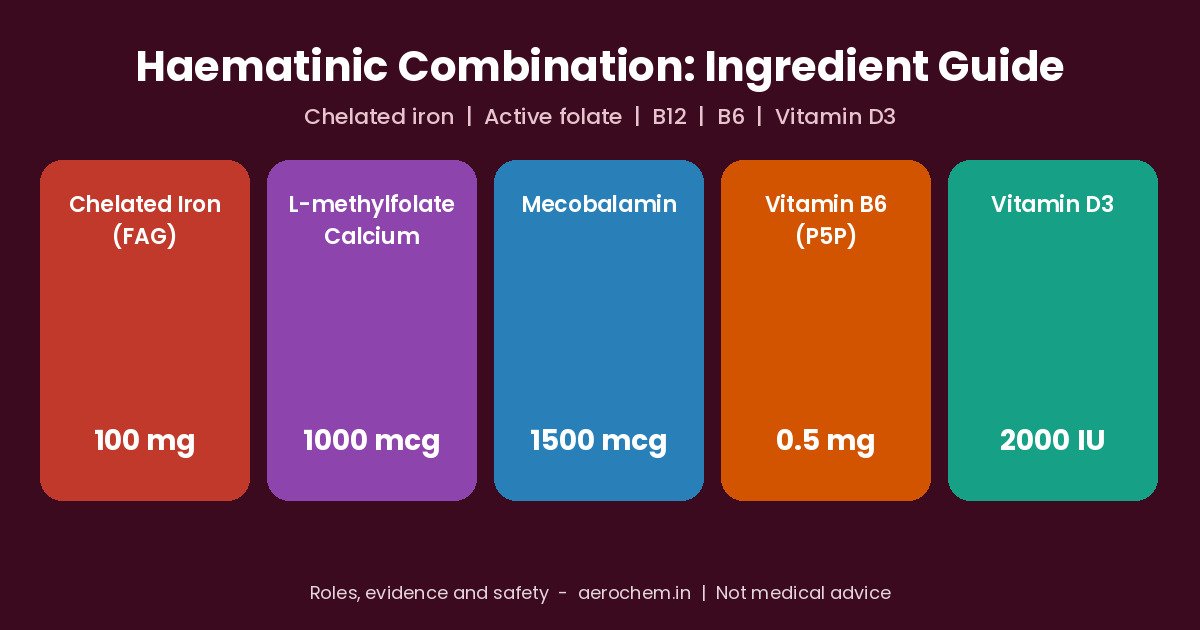
Per softgel capsule, as listed on the product page and the printed catalogue:
| Ingredient | Per softgel |
|---|---|
| Ferrous aspartoglycinate | 100 mg |
| L-methylfolate calcium | 1000 mcg |
| Mecobalamin (methylcobalamin) | 1500 mcg |
| Pyridoxal-5-phosphate (vitamin B6, P5P) | 0.5 mg |
| Cholecalciferol (vitamin D3) | 2000 IU |
Dosage form: softgel capsules. Pack size: 3 x 10 (30 softgels), as shown on the pack. The product page describes MYOSIN-HBD3 as a prescription medicine, for use on the prescription of a registered medical practitioner. The listing does not state the elemental iron content of the 100 mg ferrous aspartoglycinate salt.
Iron pathway: ferrous aspartoglycinate (100 mg)
What it is. Iron is an essential mineral needed to make haemoglobin and myoglobin, and for many enzymes (NIH ODS, Iron). Ferrous aspartoglycinate (also written ferrous asparto-glycinate) is an amino-acid-chelated oral iron, in which ferrous iron is bound to aspartic acid and glycine. It is not the same compound as ferrous sulfate, ferrous ascorbate or ferrous bisglycinate, and evidence for one chelate should not be read across to another.
Dose context. The product page lists 100 mg of the chelate and does not state how much elemental iron that provides. Only elemental iron is absorbed, so the elemental amount should be confirmed from the approved label before any dose is compared with dietary requirements or with other iron products (NIH ODS, Iron). For context, the ICMR-NIN 2020 RDA is 29 mg iron for adult women and 19 mg for adult men (ICMR-NIN 2020 brief note).
Who may have low iron. Women of reproductive age (menstrual blood loss), pregnant women, people with low dietary iron intake, people with blood loss or malabsorption, and some infants and adolescents (NIH ODS).
What the evidence shows. Oral iron is a standard approach to iron deficiency when medical assessment confirms it is needed. A small 28-day randomised trial in 73 pregnant women in India reported a greater rise in haemoglobin and ferritin with ferrous aspartoglycinate than with ferrous ascorbate; the authors themselves said larger trials were needed (Kamdi and Palkar, 2015). A 2022 clinical review of oral iron in adults notes that, despite many small studies, there is not strong evidence that any one oral iron preparation is clearly superior to the others (Lo et al., Eur J Haematol). This article does not claim that this softgel is better tolerated or more effective than other iron products.
Safety. Keep all iron-containing products out of reach of children; accidental overdose is a leading cause of fatal poisoning in young children. Common side effects of oral iron include constipation, nausea, gastrointestinal upset and dark stools. Iron can reduce absorption of levothyroxine, some antibiotics and bisphosphonates; separate the doses as advised. People with haemochromatosis or other iron-overload states should not take iron without medical advice (NIH ODS).
One-carbon nutrients: L-methylfolate calcium (1000 mcg) and mecobalamin (1500 mcg)
Folate and vitamin B12 both take part in one-carbon metabolism and in the formation of blood cells, which is why they often appear together in haematinic formulas.
L-methylfolate calcium (1000 mcg)
What it is. Folate is the natural form of vitamin B9; folic acid is the synthetic form used in many supplements and fortified foods. L-5-methyltetrahydrofolate (L-methylfolate) is the main circulating active form of folate. This product lists the calcium salt of L-methylfolate at 1000 mcg (Pietrzik et al., 2010; Scaglione and Panzavolta, 2014).
Role. Folate is needed for DNA synthesis and for converting homocysteine to methionine. Inadequate folate in early pregnancy increases the risk of neural tube defects, which is why peri-conception folic acid is widely recommended (NIH ODS, Folate). Official prevention advice typically refers to folic acid. This article does not claim that this softgel prevents neural tube defects.
Dose context. The ICMR-NIN 2020 folate RDA is 220 mcg dietary folate equivalents (DFE) for adult women and 300 mcg DFE for adult men (ICMR-NIN 2020 brief note). 1000 mcg L-methylfolate calcium is a higher, supplemental amount and is not a dietary RDA dose. Folic acid and L-methylfolate are not identical compounds. People with reduced MTHFR enzyme activity convert folic acid to the active form less efficiently; whether that matters clinically for routine supplementation is still debated, and this article makes no product claim on that point (Scaglione and Panzavolta, 2014).
Safety. Folate is water-soluble and generally well tolerated at nutritional doses. High folate intake can mask the haematological signs of vitamin B12 deficiency while neurological damage continues, so B12 status matters when folate is given (NIH ODS).
Mecobalamin (1500 mcg)
What it is. Mecobalamin is methylcobalamin, an active coenzyme form of vitamin B12. Vitamin B12 is needed for red blood cell formation, neurological function and DNA synthesis (NIH ODS, Vitamin B12).
Who may have low levels. Strict vegetarians and vegans (little dietary B12), older adults with reduced absorption, people with pernicious anaemia or after certain gut surgeries, and long-term metformin or acid-suppressing drug users (NIH ODS).
Dose context and evidence. B12 deficiency can cause megaloblastic anaemia and irreversible nerve damage if untreated. Oral and injected forms are used depending on the cause. 1500 mcg is well above the ICMR-NIN 2020 adult RDA of 2.2 mcg (ICMR-NIN 2020 brief note). It is a common supplemental amount in Indian combinations and does not replace diagnosis of deficiency.
Safety. B12 has low toxicity; no upper limit has been set in the US because of low risk at usual intakes (NIH ODS).
Coenzyme B6: pyridoxal-5-phosphate (0.5 mg)
What it is. Vitamin B6 exists as several forms; pyridoxal-5-phosphate (P5P) is the active coenzyme form involved in amino acid metabolism, haem synthesis and neurotransmitter synthesis (NIH ODS, Vitamin B6).
Dose context. The ICMR-NIN 2020 RDA is 1.9 mg for adult women and 2.4 mg for adult men (ICMR-NIN 2020 brief note). 0.5 mg is a small nutritional amount, well below doses linked to sensory neuropathy (typically long-term intakes above 100 mg/day) (NIH ODS).
Safety. At this dose, B6-related neuropathy is not a practical concern. People taking high-dose B6 from other products should still add up total intake.
Vitamin D pathway: cholecalciferol (2000 IU)
What it is. Cholecalciferol is vitamin D3. Vitamin D is involved in calcium absorption and bone mineralisation (NIH ODS, Vitamin D).
Why it may be paired with a haematinic. Some combinations add vitamin D as nutritional co-support, particularly where dietary vitamin D intake may also be low. Vitamin D is not a substitute for iron, folate or B12, and this article does not claim that vitamin D treats anaemia.
Dose context. The ICMR-NIN 2020 vitamin D RDA is 600 IU (EAR 400 IU) for adult men and women (ICMR-NIN 2020 brief note). 2000 IU is above that RDA. The NIH Office of Dietary Supplements cites a tolerable upper intake level of 4,000 IU a day for adults (NIH ODS, Vitamin D).
Safety. Excess vitamin D can cause hypercalcaemia. Combined calcium and vitamin D intake, high-dose regimens and some medical conditions raise that risk. Vitamin D should be used under medical advice, particularly in pregnancy and lactation, and should not be added on top of other high-dose vitamin D products without a prescriber’s review (NIH ODS).
Putting the five together: rationale, not proof
The combination pairs chelated oral iron with active folate and methylcobalamin (both involved in blood-cell formation and one-carbon metabolism), a small amount of active B6, and vitamin D3 (involved in calcium absorption and bone mineralisation). That is a nutritional rationale for a multi-nutrient haematinic-style formula. It is not evidence that this softgel corrects anaemia, improves bone health, or is better tolerated than other iron products, and no clinical trial of this specific formulation is cited here.
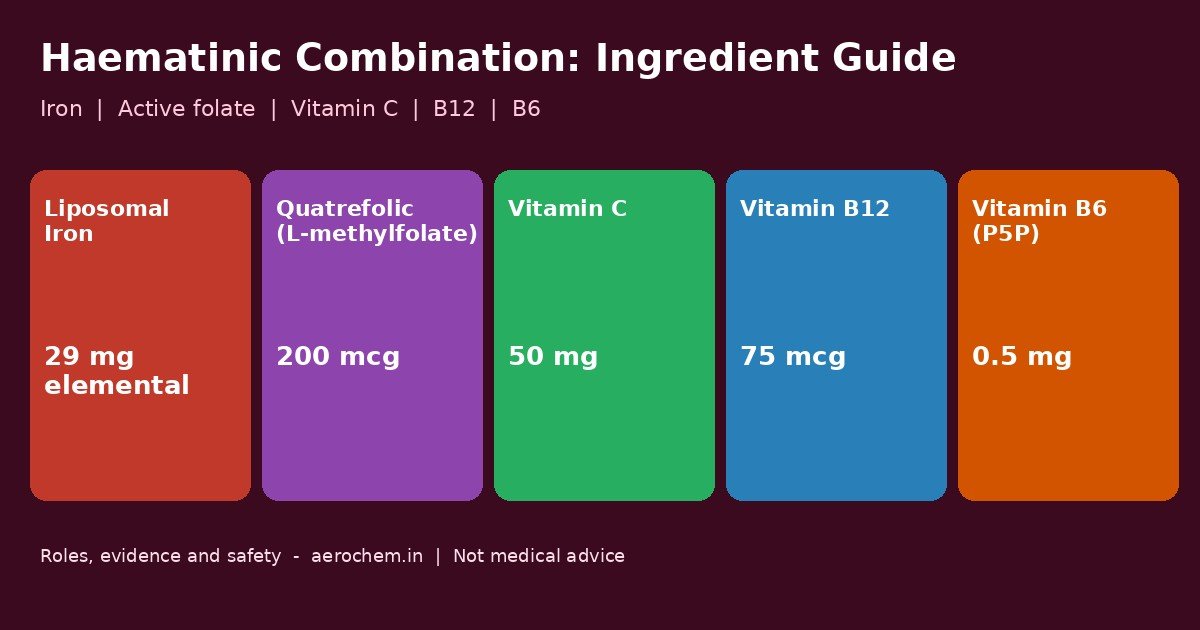
For a different iron-and-folate combination in the same gynaecology range, see our guide to liposomal iron, active folate, vitamin C, B12 and B6.
Safety checklist for prescribers and chemists
- Children: iron overdose is dangerous; keep out of reach.
- Confirmed need: iron-containing products should follow clinical assessment, not routine self-medication.
- Elemental iron: confirm the elemental amount from the approved label before comparing doses.
- Drug interactions: separate iron from levothyroxine, tetracyclines, quinolones and bisphosphonates as advised.
- Folate and B12: do not let folate supplementation delay diagnosis of B12 deficiency.
- Vitamin D: review total intake from other products; watch for hypercalcaemia risk where intake is high or calcium is also being taken.
- Pregnancy and lactation: dosing and monitoring are clinical decisions.
- Iron overload: avoid unsupervised use in haemochromatosis or similar conditions.
Why this matters for distributors
Haematinics are a core gynaecology and general-practice segment, and doctors increasingly ask about the iron salt or chelate, whether elemental iron is stated, the folate form, the B12 dose, and why vitamin D is included. Distributors who can answer accurately, without overclaiming, build more trust. Before adding a product, use our PCD franchise due diligence checklist, and plan margins with the PTR/PTS calculator and scheme calculator.
Promoting it responsibly
Promotion to healthcare professionals should follow the Uniform Code for Pharmaceutical Marketing Practices (UCPMP) 2024, as amended on 1 September 2025 (Department of Pharmaceuticals). Keep claims accurate, balanced and supported. A haematinic should not be promoted as a cure for anaemia or as a substitute for medical assessment and treatment.
About Aerochem Neutron
Aerochem Neutron markets a portfolio of more than 250 formulations across therapeutic segments. Production is coordinated through eligible partner facilities. Learn more about our PCD pharma franchise programme.
Frequently asked questions
What is in MYOSIN HBD3?
Per softgel capsule, as listed on the product page: ferrous aspartoglycinate 100 mg, L-methylfolate calcium 1000 mcg, mecobalamin 1500 mcg, pyridoxal-5-phosphate 0.5 mg and cholecalciferol 2000 IU. The elemental iron content of the 100 mg chelate is not stated on the product page.
Is MYOSIN HBD3 a medicine or a supplement?
The product page lists it as a prescription medicine in the haematinic range, for use on the prescription of a registered medical practitioner. It is not a substitute for medical assessment or treatment of anaemia.
Does MYOSIN HBD3 treat anaemia?
No. This article makes no treatment or disease claim. The product is not intended to diagnose, treat, cure or prevent any disease. Whether an iron-containing product is appropriate is a clinical decision.
What is ferrous aspartoglycinate?
An amino-acid-chelated oral iron, in which ferrous iron is bound to aspartic acid and glycine. It is not the same as ferrous sulfate, ferrous ascorbate or ferrous bisglycinate. Confirm the elemental iron amount from the approved label.
Why are folate and vitamin B12 in the same softgel?
Both are involved in blood-cell formation and one-carbon metabolism. High folate intake can also mask the haematological signs of B12 deficiency, so the two nutrients are often considered together.
Why is vitamin D3 included?
Vitamin D is involved in calcium absorption and bone mineralisation. That is a nutritional rationale for including it. It is not evidence that vitamin D treats anaemia.
Is MYOSIN HBD3 available for PCD franchise in my district?
Territory availability depends on existing partners. Use the button below to check your area.
Check your territory
Interested in adding MYOSIN HBD3 and the wider gynaecology range to your portfolio?
Check PCD Franchise Territory Availability
Have a question about a specific product? Contact our team.
Sources
- International Institute for Population Sciences (IIPS) and ICF. National Family Health Survey (NFHS-5), 2019-21, India National Fact Sheet. https://dhsprogram.com/pubs/pdf/OF43/India_National_Fact_Sheet.pdf
- Press Information Bureau, Ministry of Health and Family Welfare. Anaemia Mukt Bharat. 4 February 2022. https://www.pib.gov.in/PressReleasePage.aspx?PRID=1795421
- ICMR-National Institute of Nutrition. A Brief Note on Nutrient Requirements for Indians, the Recommended Dietary Allowances (RDA) and the Estimated Average Requirements (EAR), 2020. https://www.nin.res.in/rdabook/brief_note.pdf
- NIH Office of Dietary Supplements. Iron: Fact Sheet for Health Professionals. https://ods.od.nih.gov/factsheets/Iron-HealthProfessional/
- NIH Office of Dietary Supplements. Folate: Fact Sheet for Health Professionals. https://ods.od.nih.gov/factsheets/Folate-HealthProfessional/
- NIH Office of Dietary Supplements. Vitamin B12: Fact Sheet for Health Professionals. https://ods.od.nih.gov/factsheets/VitaminB12-HealthProfessional/
- NIH Office of Dietary Supplements. Vitamin B6: Fact Sheet for Health Professionals. https://ods.od.nih.gov/factsheets/VitaminB6-HealthProfessional/
- NIH Office of Dietary Supplements. Vitamin D: Fact Sheet for Health Professionals. https://ods.od.nih.gov/factsheets/VitaminD-HealthProfessional/
- Pietrzik K, Bailey L, Shane B. Folic acid and L-5-methyltetrahydrofolate: comparison of clinical pharmacokinetics and pharmacodynamics. Clin Pharmacokinet 2010. https://pubmed.ncbi.nlm.nih.gov/20608755/
- Scaglione F, Panzavolta G. Folate, folic acid and 5-methyltetrahydrofolate are not the same thing. Xenobiotica 2014. https://pubmed.ncbi.nlm.nih.gov/24494987/
- Kamdi SP, Palkar PJ. Efficacy and safety of ferrous asparto glycinate in the management of iron deficiency anaemia in pregnant women. J Obstet Gynaecol 2015;35(1):4-8. https://pubmed.ncbi.nlm.nih.gov/24959663/
- Lo JO, Benson AE, Martens K, et al. Oral iron treatment in adult iron deficiency. Eur J Haematol. https://pubmed.ncbi.nlm.nih.gov/36336470/
- Department of Pharmaceuticals. Uniform Code for Pharmaceutical Marketing Practices 2024, consolidated text updated as on 1.9.2025. https://ucmp.pharma-dept.gov.in/Pharma/UCPMP%202024%20for%20website_0.pdf