For healthcare professionals and trade partners. General information, not medical advice. MONYCAL PLUS is a nutritional formulation and is not intended to diagnose, treat, cure or prevent any disease.
"Doctor, why do I hurt everywhere?"
It is one of the most common complaints in a gynaecology or orthopaedic clinic. A woman in her late 40s or early 50s describes aching knees, stiff fingers, sore shoulders and low energy. Her reports may look normal. Hot flushes get most of the attention, but for many women the musculoskeletal side of menopause, including joint pain, muscle loss and quiet bone loss, matters just as much.
This guide looks at that side of menopause, the physiology behind it, and how the ingredients in MONYCAL PLUS softgels map to those pathways.
Key data points
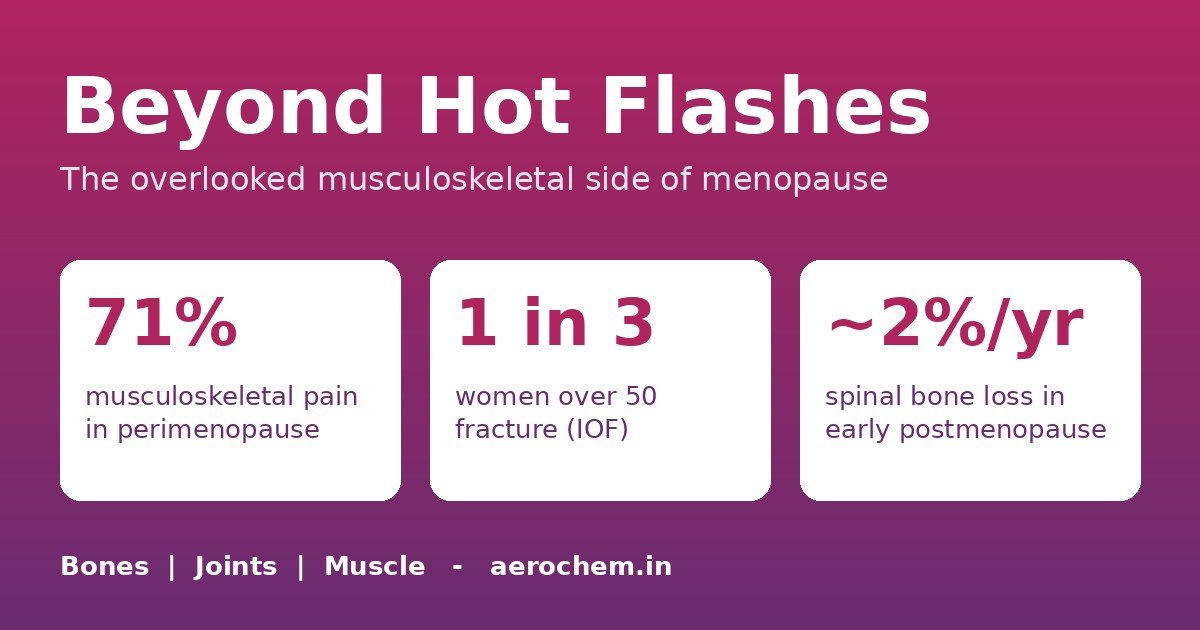
71% of perimenopausal women report musculoskeletal pain, according to a 2020 meta-analysis of 16 studies (Neural Plast 2020).
About 65%: joint and muscular discomfort was the most prevalent menopausal symptom in a 2024 global meta-analysis of 321 studies (BMC Public Health 2024).
1 in 3 women over 50 will experience an osteoporotic fracture, according to the International Osteoporosis Foundation (IOF).
About 2% a year: average spinal bone loss in early postmenopause in the US SWAN cohort, after loss accelerates in late perimenopause (Finkelstein et al., JCEM 2008).
What changes after menopause
| Area | What happens (general physiology) |
|---|---|
| Estrogen decline | Estrogen levels fall across the menopause transition. Estrogen normally restrains bone resorption (Khosla et al., 2012). |
| Bone | With less estrogen, osteoclast activity rises and bone loss speeds up, most rapidly in late perimenopause and early postmenopause (Finkelstein et al., 2008). |
| Joints and muscle | Muscle and joint pain become more common, and postmenopausal women have higher odds of moderate to severe pain than premenopausal women (Neural Plast 2020). |
| Result | Higher fracture risk with age (IOF) and symptoms that can limit daily activity. |
The cycle
Researchers describe a pattern that may reinforce itself, although the links are still being studied and differ from woman to woman:
Estrogen drop → possible rise in low-grade inflammation and pain → less activity → muscle and bone loss → more joint stress → more pain
This is a general concept, not a fixed sequence. It helps explain why physicians often consider diet, activity, weight, bone health and symptom relief together.
Why a single-nutrient approach may not cover everything
Calcium is the main mineral in bone, but how well it is absorbed depends on adequate vitamin D, and absorption declines with age (NIH ODS, Calcium). Bone metabolism also involves magnesium, vitamin K-dependent proteins and other cofactors. That is why many formulations combine several nutrients.
Hormone therapy, analgesics, physiotherapy, exercise and nutrition each have their place. The choice of therapy is always the treating doctor's, based on the individual patient.
MONYCAL PLUS: a multi-nutrient formulation by pathway
Bone nutrients
- Calcium 500 mg, magnesium 35 mg and iron 1 mg from Aquamin, a calcified seaweed (Lithothamnion sp.) mineral source. Calcium is the main structural mineral of bone (NIH ODS).
- Vitamin K2-7 45 mcg (as VitaMK7). Vitamin K is involved in activating proteins such as osteocalcin in bone and matrix Gla protein (NIH ODS, Vitamin K).
- Vitamin D3 400 IU (as Vitashine). Vitamin D is involved in calcium absorption and bone mineralisation (NIH ODS, Vitamin D).
Joint nutrients
- Omega-3 fatty acid 50 mg. EPA and DHA are parts of cell membranes and give rise to signalling molecules involved in inflammation (NIH ODS, Omega-3).
- Evening primrose oil 220 mg, a source of gamma-linolenic acid (GLA). It has been studied for several conditions, but the evidence is limited (NCCIH).
Muscle nutrients
- Magnesium oxide 90 mg (about 54 mg elemental magnesium). Magnesium is involved in muscle contraction, nerve function and bone formation (NIH ODS, Magnesium).
- Vitamin B6 1 mg. Involved in amino acid and protein metabolism (NIH ODS, Vitamin B6).
Menopause botanicals
- Black cohosh 50 mg. It is studied for menopausal symptoms, with conflicting results so far (NCCIH).
- Soya isoflavones 20% 60 mg. These plant compounds have weak estrogen-like activity and are studied for hot flushes, where the evidence is inconsistent (NCCIH).
- Melatonin 1 mg. A hormone involved in regulating the sleep-wake cycle (NCCIH).
Others
- Ginkgo biloba 10 mg. It is studied mainly for memory and circulation, and large trials have not shown that it prevents cognitive decline (NCCIH).
- Vitamin E 5 mg. A fat-soluble antioxidant that protects cell membranes (NIH ODS, Vitamin E).
Grouping ingredients by pathway explains the formulation's rationale. It is not evidence that the product changes any outcome.
Full composition (per softgel)
| Ingredient | Amount |
|---|---|
| Calcium (as Aquamin, Lithothamnion sp.) | 500 mg |
| Iron (as Aquamin) | 1 mg |
| Magnesium (as Aquamin) | 35 mg |
| Vitamin K2-7 (as VitaMK7) | 45 mcg |
| Vitamin D3 (as Vitashine) | 400 IU |
| Melatonin | 1 mg |
| Soya Isoflavones 20% | 60 mg |
| Magnesium Oxide | 90 mg |
| Evening Primrose Oil | 220 mg |
| Omega-3 Fatty Acid | 50 mg |
| Vitamin E | 5 mg |
| Ginkgo Biloba | 10 mg |
| Vitamin B6 | 1 mg |
| Black Cohosh | 50 mg |
The label states that it is formulated with the trade-marked ingredients Aquamin, Vitashine and VitaMK7.
Safety at a glance
- Liver: cases of liver injury have been reported with black cohosh. Avoid it in liver disease (NCCIH).
- Hormone-sensitive conditions: women with, or at high risk of, breast or other hormone-sensitive cancers should consult their doctor before taking isoflavones (NCCIH).
- Bleeding: ginkgo, evening primrose oil, omega-3 and vitamin E may add to bleeding risk, and vitamin K affects warfarin. Check anticoagulant or antiplatelet use, and stop before surgery as advised.
- Melatonin: may cause drowsiness. Avoid driving after a dose.
- Magnesium: about 89 mg elemental in total per softgel. Count antacids and other supplements, and take care in kidney disease.
- Pregnancy and breastfeeding: not without medical advice.
Why this matters for distributors
Gynaecologists and orthopaedic surgeons increasingly ask about the musculoskeletal side of menopause, and they expect ingredient-level answers. A distributor who can explain each pathway accurately, without overclaiming, builds lasting credibility. Before adding any product, use our PCD franchise due diligence checklist, and plan margins with the PTR/PTS calculator and scheme calculator. For another label guide, see how to read a CoQ10 multinutrient supplement label.
Promoting it responsibly
Promotion to healthcare professionals should follow the Uniform Code for Pharmaceutical Marketing Practices (UCPMP) 2024, as amended on 1 September 2025 (Department of Pharmaceuticals). Claims must be accurate, balanced and verifiable.
About Aerochem Neutron
Aerochem Neutron markets more than 250 formulations across therapeutic segments, with production coordinated through eligible partner facilities. Learn about our PCD pharma franchise programme.
Frequently asked questions
Is joint pain common around menopause?
Yes. A 2020 meta-analysis estimated that 71% of perimenopausal women report musculoskeletal pain.
How fast is bone lost after menopause?
In the SWAN cohort, spinal bone loss in early postmenopause averaged about 2% a year, after accelerating in late perimenopause.
What is in MONYCAL PLUS?
Fourteen ingredients grouped by pathway: bone nutrients (Aquamin calcium, magnesium and iron, vitamin K2-7 45 mcg, vitamin D3 400 IU), joint nutrients (omega-3, evening primrose oil), muscle nutrients (magnesium oxide, vitamin B6), botanicals (black cohosh, soya isoflavones, melatonin), and ginkgo and vitamin E.
Does MONYCAL PLUS treat menopause?
No. It is a nutritional formulation and is not intended to treat any condition. The choice of therapy is the doctor's.
Who should check with a doctor first?
People with liver disease, a history of hormone-sensitive cancer, those on anticoagulants, warfarin or sedatives, people with kidney disease, and pregnant or breastfeeding women.
Is MONYCAL PLUS available for PCD franchise in my district?
Territory availability depends on existing partners. Use the button below to check your area.
Check your territory
Add MONYCAL PLUS and the wider gynaecology range to your portfolio.
Check PCD Franchise Territory Availability
Questions about a product? Contact our team.
Sources
- Musculoskeletal Pain during the Menopausal Transition: A Systematic Review and Meta-Analysis. Neural Plast 2020. https://doi.org/10.1155/2020/8842110
- Mapping global prevalence of menopausal symptoms among middle-aged women: a systematic review and meta-analysis. BMC Public Health 2024. https://doi.org/10.1186/s12889-024-19280-5
- International Osteoporosis Foundation. Epidemiology of osteoporosis and fragility fractures. https://www.osteoporosis.foundation/facts-statistics/epidemiology-of-osteoporosis-and-fragility-fractures
- Finkelstein JS, et al. Bone mineral density changes during the menopause transition in a multiethnic cohort of women. J Clin Endocrinol Metab 2008. https://pubmed.ncbi.nlm.nih.gov/18160467/
- Khosla S, Oursler MJ, Monroe DG. Estrogen and the skeleton. Trends Endocrinol Metab 2012. https://pubmed.ncbi.nlm.nih.gov/22595550/
- NIH ODS fact sheets for health professionals: Calcium, Magnesium, Vitamin D, Vitamin K, Omega-3 Fatty Acids, Vitamin B6, Vitamin E. https://ods.od.nih.gov/
- NCCIH: Black Cohosh, Soy, Melatonin, Ginkgo, Evening Primrose Oil. https://www.nccih.nih.gov/health/
- Department of Pharmaceuticals. Uniform Code for Pharmaceutical Marketing Practices 2024, consolidated text updated as on 1.9.2025. https://ucmp.pharma-dept.gov.in/Pharma/UCPMP%202024%20for%20website_0.pdf