Joint nutrition products have moved well beyond plain glucosamine. Many tablets sold in India now combine structural nutrients, botanical extracts, vitamins and trace minerals in one strip. For doctors, chemists and distributors, the useful question is not "does it work?" but "what is each ingredient, what does the evidence actually show, and what safety points matter?"
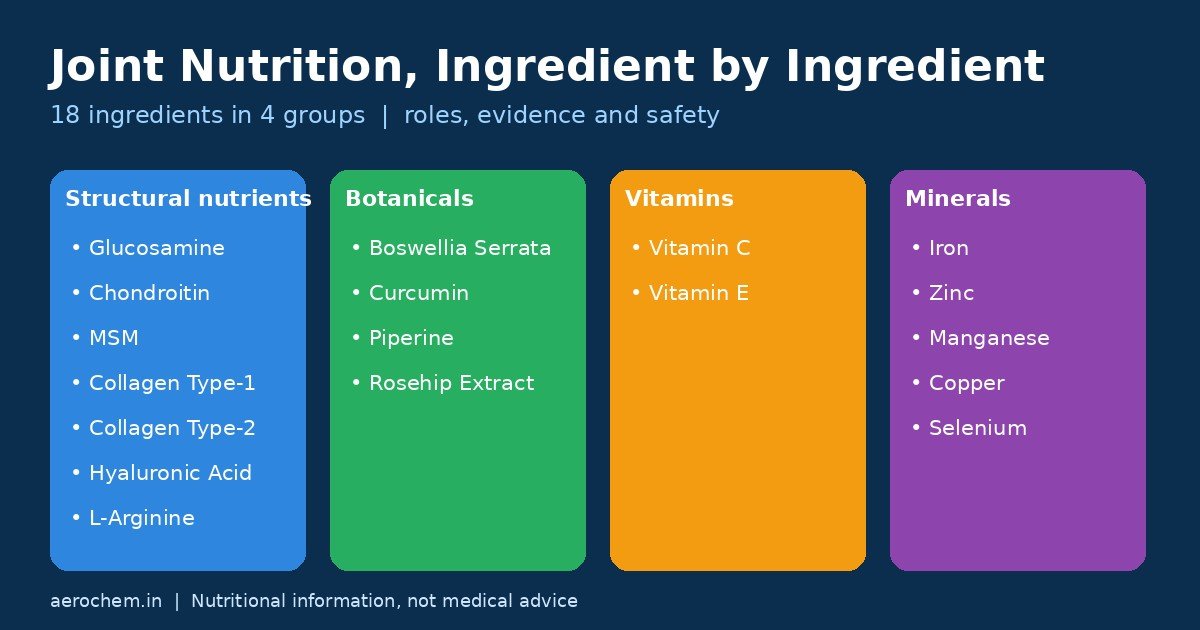
This guide uses LINKACE tablets, a joint nutrition supplement in the Aerochem Neutron orthopaedic range, as a worked example. It covers all 18 ingredients in four groups. This is general information for healthcare professionals and trade partners, not medical advice. LINKACE is a nutritional supplement and is not intended to diagnose, treat, cure or prevent any disease.
What is in LINKACE
Per tablet, as supplied by the company:
| Group | Ingredient | Per tablet |
|---|---|---|
| Joint structural nutrients | Glucosamine | 250 mg |
| Chondroitin Sulphate | 100 mg | |
| Methyl Sulphonyl Methane (MSM) | 100 mg | |
| Collagen Peptide Type-1 | 50 mg | |
| Collagen Peptide Type-2 | 50 mg | |
| Hyaluronic Acid | 50 mg | |
| L-Arginine | 100 mg | |
| Botanicals | Rosehip Extract | 100 mg |
| Boswellia Serrata | 100 mg | |
| Curcumin | 50 mg | |
| Piperine | 5 mg | |
| Vitamins | Vitamin C | 80 mg |
| Vitamin E | 20 mg | |
| Minerals | Iron | 5 mg |
| Zinc | 5 mg | |
| Manganese | 2 mg | |
| Copper | 0.5 mg | |
| Selenium | 60 mcg |
Dosage form: tablets, packed 3 x 10 Alu-Alu. Use as directed on the approved label or by a healthcare professional.
Joint structural nutrients
Glucosamine (250 mg) and chondroitin sulphate (100 mg). Both are natural components of cartilage. They are the best-studied joint supplements, and the results are mixed. In the large NIH-funded GAIT trial, neither glucosamine hydrochloride nor chondroitin, alone or together, relieved knee osteoarthritis pain better than placebo in the overall group, and later analyses found no meaningful effect on joint-space loss (NCCIH). Some studies of glucosamine sulfate show modest effects, but trial quality and formulation vary. Glucosamine is often made from shellfish shells, and there are reports that it may increase the effect of warfarin, so people with shellfish allergy or on anticoagulants should consult their doctor (NCCIH). Note that trial doses were typically 1,500 mg glucosamine and 1,200 mg chondroitin per day, far more than one tablet provides.
MSM (100 mg). Methylsulfonylmethane is an organic sulphur compound. Small trials in knee osteoarthritis have reported modest changes in pain scores, but the studies are few, short and small (Butawan et al., Nutrients 2017). It is generally well tolerated.
Collagen peptides Type-1 and Type-2 (50 mg each). Collagen is the main structural protein of tendon, bone (mostly type I) and cartilage (mostly type II). Hydrolysed collagen peptides supply amino acids such as glycine, proline and hydroxyproline. Clinical studies of collagen supplements for joint symptoms exist, but they use different collagen types and much larger doses (often several grams of hydrolysed collagen, or around 40 mg of undenatured type II), and their quality is variable (García-Coronado et al., Int Orthop 2019). Collagen is animal-derived, which matters for vegetarian customers and people with fish or other allergies; ask the company about the source.
Hyaluronic acid (50 mg). Hyaluronic acid is a natural component of synovial fluid and cartilage. Most clinical evidence concerns injections into the knee, not tablets. Evidence for oral hyaluronic acid is limited to small trials.
L-Arginine (100 mg). A conditionally essential amino acid and the precursor of nitric oxide; it also feeds into proline, which is used in collagen synthesis. There is no direct evidence on joint health at this dose. Arginine supplements can interact with blood-pressure medicines and nitrates at high doses, so mention it to the prescribing doctor.
Botanicals
Boswellia serrata (100 mg). Indian frankincense resin, long used in Ayurveda. Its boswellic acids have been studied for osteoarthritis; a meta-analysis found improvements in pain and function scores, but most trials were small and some were industry-funded (Yu et al., BMC Complement Med Ther 2020). The label does not state the standardisation, so ask the company before quoting a boswellic acid content.
Curcumin (50 mg) and piperine (5 mg). Curcumin is the main active compound in turmeric. It is poorly absorbed, which is why it is often paired with piperine, a black pepper alkaloid that increases curcumin absorption (NCCIH, Turmeric). NCCIH notes that turmeric has been studied for osteoarthritis but the evidence is not conclusive, and that liver injury has been reported with turmeric supplements, especially those with piperine. Piperine can also change how some drugs are metabolised. Curcumin may increase bleeding risk with anticoagulants.
Rosehip extract (100 mg). Rosehip is the fruit of the dog rose (Rosa canina), a natural source of vitamin C and polyphenols. A meta-analysis of a specific rosehip powder suggested a small reduction in osteoarthritis pain, based on only three trials (Christensen et al., Osteoarthritis Cartilage 2008). Those trials used several grams per day.
Vitamins
Vitamin C (80 mg). An essential nutrient and a cofactor for enzymes that stabilise collagen. Deficiency (scurvy) causes poor wound healing and joint pain. The adult upper limit in the US is 2,000 mg/day, so 80 mg is a nutritional amount (NIH ODS, Vitamin C).
Vitamin E (20 mg). A fat-soluble antioxidant that protects cell membranes. Deficiency is rare in healthy people. High-dose vitamin E may increase bleeding risk with anticoagulants (NIH ODS, Vitamin E).
Minerals
Iron (5 mg). Needed for haemoglobin and many enzymes. Iron supplements can reduce absorption of some drugs, such as levothyroxine and some antibiotics, and should be kept away from children because accidental overdose is dangerous (NIH ODS, Iron).
Zinc (5 mg). Required for many enzymes, immune function and wound healing. Zinc competes with copper for absorption, which is one reason both appear here (NIH ODS, Zinc).
Manganese (2 mg). A cofactor for enzymes involved in forming cartilage proteoglycans and bone, and for the antioxidant enzyme manganese superoxide dismutase (NIH ODS, Manganese).
Copper (0.5 mg). Needed for lysyl oxidase, the enzyme that cross-links collagen and elastin, and for iron metabolism (NIH ODS, Copper).
Selenium (60 mcg). Part of selenoproteins such as glutathione peroxidases, which are involved in antioxidant defence. The adult upper limit in the US is 400 mcg/day (NIH ODS, Selenium).
Putting the 18 together: rationale, not proof
The combination brings together nutrients associated with connective tissue structure (glucosamine, chondroitin, collagen, hyaluronic acid, MSM), the cofactors that collagen formation depends on (vitamin C, copper, manganese, zinc), antioxidant nutrients (vitamin E, selenium) and botanicals studied for joint comfort. That is a nutritional rationale. It is not evidence that this tablet improves joint outcomes, and no clinical trial of this specific formulation is cited here. Many of the per-tablet amounts are well below the doses used in trials of individual ingredients.
Safety checklist for prescribers and chemists
- Anticoagulants and antiplatelets: glucosamine, curcumin and vitamin E have been linked to increased bleeding risk. Check with the treating doctor.
- Allergies: glucosamine and collagen may come from shellfish, fish or animal sources.
- Liver: turmeric and piperine products have been linked to rare liver injury.
- Drug interactions: iron and other minerals can reduce absorption of certain medicines; separate the doses as advised.
- Pregnancy, breastfeeding and children: seek medical advice.
- Not a replacement for treatment: LINKACE should not replace prescribed medicines, physiotherapy or other care for osteoarthritis or joint disease.
Why this matters for distributors
Orthopaedic nutrition is a steady prescription segment, and doctors increasingly ask detailed questions about multi-ingredient products. Distributors who can explain each ingredient honestly, including the limits of the evidence, build more credibility than those who repeat broad claims. Before adding a product, use our PCD franchise due diligence checklist, and plan margins with the PTR/PTS calculator and scheme calculator.
Promoting it responsibly
Promotion to healthcare professionals should follow the Uniform Code for Pharmaceutical Marketing Practices (UCPMP) 2024, as amended on 1 September 2025 (Department of Pharmaceuticals). Keep claims accurate, balanced and supported, and do not describe a nutritional supplement as a treatment.
About Aerochem Neutron
Aerochem Neutron markets a portfolio of more than 250 formulations across therapeutic segments. Production is coordinated through eligible partner facilities. Learn more about our PCD pharma franchise programme.
Frequently asked questions
What is in LINKACE?
Eighteen ingredients per tablet: glucosamine, chondroitin sulphate, MSM, collagen peptides type 1 and type 2, hyaluronic acid, L-arginine, rosehip extract, Boswellia serrata, curcumin, piperine, vitamins C and E, and iron, zinc, manganese, copper and selenium.
Is LINKACE a medicine?
No. It is a nutritional supplement and is not intended to diagnose, treat, cure or prevent any disease.
Does glucosamine with chondroitin work for knee osteoarthritis?
Evidence is mixed. In the large NIH-funded GAIT trial, the combination did not relieve pain better than placebo in the overall group.
Why does it contain piperine?
Piperine, from black pepper, increases the absorption of curcumin, which on its own is poorly absorbed.
Who should check with a doctor before using it?
People taking anticoagulants or other regular medicines, those with shellfish or fish allergies or liver disease, pregnant or breastfeeding women, and children.
Is LINKACE available for PCD franchise in my district?
Territory availability depends on existing partners. Use the button below to check your area.
Check your territory
Interested in adding LINKACE and the wider orthopaedic range to your portfolio?
Check PCD Franchise Territory Availability
Have a question about a specific product? Contact our team.
Sources
- NCCIH. Glucosamine and Chondroitin for Osteoarthritis. https://www.nccih.nih.gov/health/glucosamine-and-chondroitin-for-osteoarthritis
- NCCIH. Turmeric. https://www.nccih.nih.gov/health/turmeric
- Butawan M, et al. Methylsulfonylmethane: Applications and Safety of a Novel Dietary Supplement. Nutrients 2017. https://pubmed.ncbi.nlm.nih.gov/28300758/
- García-Coronado JM, et al. Effect of collagen supplementation on osteoarthritis symptoms: a meta-analysis. Int Orthop 2019. https://pubmed.ncbi.nlm.nih.gov/30368550/
- Yu G, et al. Effectiveness of Boswellia and Boswellia extract for osteoarthritis patients: a systematic review and meta-analysis. BMC Complement Med Ther 2020. https://pubmed.ncbi.nlm.nih.gov/32680575/
- Christensen R, et al. Does the hip powder of Rosa canina reduce pain in osteoarthritis patients? A meta-analysis. Osteoarthritis Cartilage 2008. https://pubmed.ncbi.nlm.nih.gov/18407528/
- NIH ODS fact sheets for health professionals: Vitamin C, Vitamin E, Iron, Zinc, Manganese, Copper, Selenium. https://ods.od.nih.gov/
- Department of Pharmaceuticals. Uniform Code for Pharmaceutical Marketing Practices 2024, consolidated text updated as on 1.9.2025. https://ucmp.pharma-dept.gov.in/Pharma/UCPMP%202024%20for%20website_0.pdf