Sleep and calmness products often list several familiar names on one strip: magnesium, L-theanine, melatonin and vitamin B6. For doctors, chemists and distributors, the useful questions are what each ingredient is, what the evidence actually shows, and which safety points matter before someone starts taking it.
This guide uses REMAGIN-CALM, a product in Aerochem Neutron's ReMagin range within the Multivitamins and Antioxidants category, as a worked example. It covers all four ingredients equally. This is general information for healthcare professionals and trade partners, not medical advice. The product is not intended to diagnose, treat, cure or prevent any disease.
What is in REMAGIN-CALM
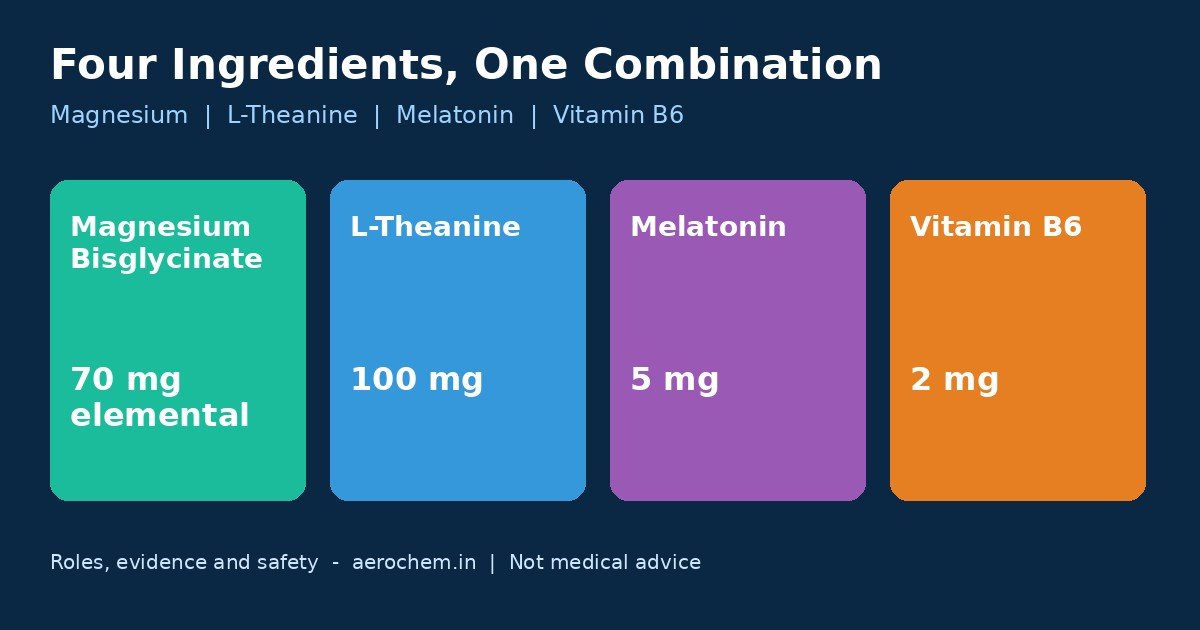
Per tablet, as listed on the product page:
| Ingredient | Per tablet |
|---|---|
| Magnesium Bisglycinate (eq. to elemental magnesium) | 70 mg |
| L-Theanine | 100 mg |
| Melatonin | 5 mg |
| Vitamin B6 (pyridoxine) | 2 mg |
Dosage form: tablets. Pack size: 3 × 10. Use as directed by a registered medical practitioner, as the listing states.
Magnesium Bisglycinate (70 mg elemental magnesium)
What it is. Magnesium is a cofactor in more than 300 enzyme systems, including those involved in muscle and nerve function, energy production and moving calcium and potassium across cell membranes (NIH ODS, Magnesium). Magnesium bisglycinate binds the mineral to glycine. Labels should state the elemental magnesium amount, which is what the 70 mg figure here refers to.
Who may have low levels. People with gut disorders such as Crohn disease or celiac disease, people with type 2 diabetes, people with alcohol dependence, and older adults. Long-term proton pump inhibitors and some diuretics can also lower magnesium (NIH ODS).
What the evidence shows. Observational work links higher magnesium intakes with better metabolic and cardiovascular markers, but those studies cannot prove cause. For sleep, a systematic review and meta-analysis of three small trials in older adults with insomnia found that oral magnesium shortened sleep onset latency by about 17 minutes compared with placebo, but the trials were at moderate-to-high risk of bias and the evidence quality was low to very low (Mah and Pitre, 2021). Neurology societies consider magnesium probably effective for migraine prevention, though the data are limited (NIH ODS).
Safety. The US upper limit for supplemental magnesium is 350 mg/day of elemental magnesium from non-food sources. Diarrhoea is the most common side effect. People with kidney impairment need caution. Magnesium can reduce absorption of some antibiotics and bisphosphonates; separate the doses as advised (NIH ODS).
For another magnesium-containing product in the same range, see our guide to the CoQ10, L-carnitine, magnesium and methylcobalamin combination.
L-Theanine (100 mg)
What it is. L-Theanine (gamma-glutamylethylamide) is an amino acid that occurs naturally in tea leaves. A typical cup of black tea provides about 20 mg (Nobre et al., Asia Pac J Clin Nutr 2008).
Role. Human EEG studies have reported increased alpha-band activity after L-theanine, a pattern associated with a relaxed but alert state, at doses higher than those in a cup of tea (Nobre et al., 2008). A narrative review of sleep-related data described anxiolytic effects without the additive profile of conventional sleep inducers, and noted that most sleep work used about 200 mg (Rao et al., J Am Coll Nutr 2015). A 2024 systematic review of L-theanine in mental disorders found mixed and limited evidence; the studies were few and heterogeneous (BMC Psychiatry 2024).
Reading this line. 100 mg is above a cup of tea and below the 200 mg used in several sleep studies. It is not evidence that this tablet improves sleep or anxiety.
Safety. L-Theanine is generally well tolerated in short-term studies. People who are pregnant, breastfeeding or taking sedatives should seek medical advice before use.
Melatonin (5 mg)
What it is. Melatonin is a hormone made by the pineal gland that helps regulate the sleep-wake cycle (NCCIH).
What the evidence shows. NCCIH notes some evidence that melatonin can help with jet lag and can help people fall asleep slightly faster. Effects on sleep quality and total sleep time are smaller and less consistent. Short-term use appears safe for most adults; long-term safety is less clear (NCCIH).
Dose context. Over-the-counter melatonin products often range from 0.5 mg to 5 mg or more. 5 mg sits at the upper end of common retail strengths. Higher doses are not always more effective and can increase next-day drowsiness.
Safety. Melatonin can cause drowsiness, headache and dizziness. People should not drive or operate machinery after taking it. It may interact with sedatives, anticoagulants, anti-epileptics and blood-pressure medicines. Melatonin's regulatory category (supplement or drug) differs between countries; confirm the category of this product in India with the company before promoting it (NCCIH).
Vitamin B6 (2 mg)
What it is. Vitamin B6 (pyridoxine and related forms) is involved in more than 100 enzyme reactions, including amino acid metabolism and the synthesis of neurotransmitters such as serotonin, dopamine and GABA (NIH ODS, Vitamin B6).
Who may have low levels. People with kidney disease, rheumatoid arthritis, alcohol dependence, and those taking certain medicines (for example isoniazid or some antiepileptics) (NIH ODS).
What the evidence shows. Clear deficiency causes neurological and skin findings. Supplementation beyond correcting deficiency has not been shown to treat sleep or anxiety disorders. The adult RDA in the US is 1.3 to 1.7 mg depending on age and sex, so 2 mg is a nutritional amount (NIH ODS).
Safety. Long-term high doses (typically well above 100 mg/day) can cause sensory neuropathy. 2 mg is far below that range (NIH ODS).
Putting the four together: rationale, not proof
The combination brings together a mineral involved in nerve and muscle function, an amino acid studied for calm alertness, a hormone involved in the sleep-wake cycle, and a vitamin involved in neurotransmitter metabolism. That is a formulation rationale. It is not evidence that this tablet improves sleep, anxiety or any other outcome, and no clinical trial of this specific product is cited here.
Safety checklist for prescribers and chemists
- Drowsiness: melatonin 5 mg can impair driving and machinery use.
- Sedatives and other CNS drugs: check interactions with melatonin and L-theanine.
- Kidneys: caution with magnesium in renal impairment.
- Drug absorption: separate magnesium from some antibiotics and bisphosphonates.
- Pregnancy and breastfeeding: seek medical advice.
- Not a replacement for care: this product should not replace assessment of insomnia, anxiety, depression or other medical conditions.
Why this matters for distributors
Sleep and calmness products are a steady enquiry segment, and doctors increasingly ask about each ingredient rather than the brand story. Distributors who can explain roles, evidence limits and safety points earn more trust. Before adding a product, use our PCD franchise due diligence checklist, and plan margins with the PTR/PTS calculator and scheme calculator. For another multi-ingredient label guide, see how to read a CoQ10 multinutrient supplement label.
Promoting it responsibly
Promotion to healthcare professionals should follow the Uniform Code for Pharmaceutical Marketing Practices (UCPMP) 2024, as amended on 1 September 2025 (Department of Pharmaceuticals). Keep claims accurate, balanced and supported, and do not describe a nutritional product as a treatment for insomnia or anxiety.
About Aerochem Neutron
Aerochem Neutron markets a portfolio of more than 250 formulations across therapeutic segments. Production is coordinated through eligible partner facilities. Learn more about our PCD pharma franchise programme.
Frequently asked questions
What is in REMAGIN-CALM?
Per tablet: magnesium bisglycinate providing 70 mg elemental magnesium, L-theanine 100 mg, melatonin 5 mg and vitamin B6 2 mg.
Does this product treat insomnia or anxiety?
No. It is not intended to diagnose, treat, cure or prevent any disease. Assessment of sleep or mood problems belongs with the treating doctor.
Will 5 mg of melatonin make patients drowsy the next day?
It can. Melatonin may cause drowsiness; advise patients not to drive or operate machinery if affected.
How does 100 mg of L-theanine compare with tea?
A typical cup of black tea has about 20 mg of L-theanine. Several sleep-related studies used about 200 mg.
Who should check with a doctor before use?
People with kidney disease, those taking sedatives, anticoagulants or other regular medicines, pregnant or breastfeeding women, and anyone with chronic insomnia or a mental health condition.
Is REMAGIN-CALM available for PCD franchise in my district?
Territory availability depends on existing partners. Use the button below to check your area.
Check your territory
Interested in adding REMAGIN-CALM and the wider ReMagin range to your portfolio?
Check PCD Franchise Territory Availability
Have a question about a specific product? Contact our team.
Sources
- NIH Office of Dietary Supplements. Magnesium: Fact Sheet for Health Professionals. https://ods.od.nih.gov/factsheets/Magnesium-HealthProfessional/
- NIH Office of Dietary Supplements. Vitamin B6: Fact Sheet for Health Professionals. https://ods.od.nih.gov/factsheets/VitaminB6-HealthProfessional/
- NCCIH. Melatonin: What You Need To Know. https://www.nccih.nih.gov/health/melatonin-what-you-need-to-know
- Mah J, Pitre T. Oral magnesium supplementation for insomnia in older adults: a Systematic Review and Meta-Analysis. BMC Complement Med Ther 2021. https://pubmed.ncbi.nlm.nih.gov/33865376/
- Nobre AC, Rao A, Owen GN. L-theanine, a natural constituent in tea, and its effect on mental state. Asia Pac J Clin Nutr 2008. https://pubmed.ncbi.nlm.nih.gov/18296328/
- Rao TP, Ozeki M, Juneja LR. In Search of a Safe Natural Sleep Aid. J Am Coll Nutr 2015. https://pubmed.ncbi.nlm.nih.gov/25759004/
- Moshfeghinia R, et al. The effects of L-theanine supplementation on the outcomes of patients with mental disorders: a systematic review. BMC Psychiatry 2024. https://pubmed.ncbi.nlm.nih.gov/39633316/
- Department of Pharmaceuticals. Uniform Code for Pharmaceutical Marketing Practices 2024, consolidated text updated as on 1.9.2025. https://ucmp.pharma-dept.gov.in/Pharma/UCPMP%202024%20for%20website_0.pdf